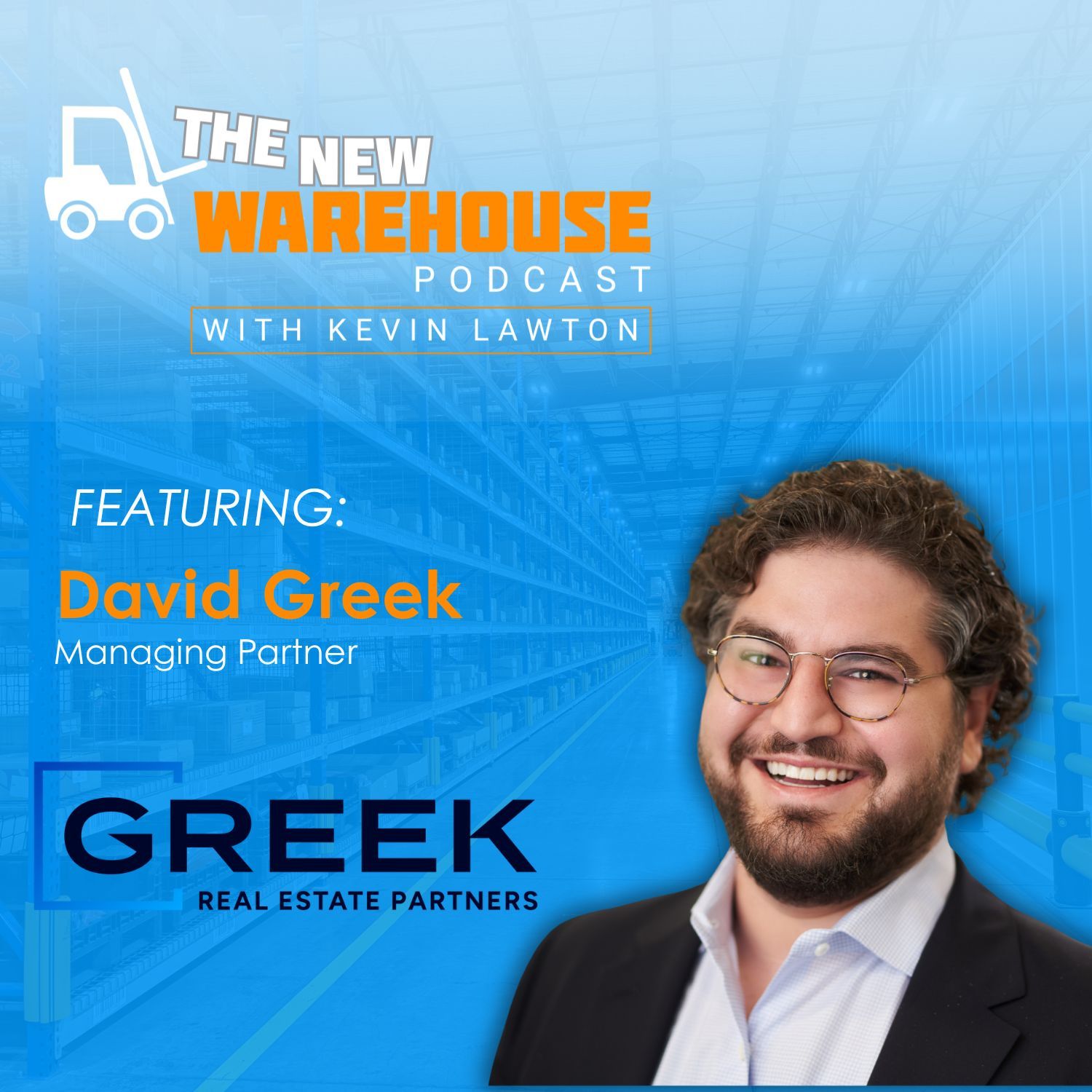
Industrial Real Estate Trends: Forces Reshaping Warehousing Today
David Greek, Managing Partner at Greek Real Estate Partners, joins The New Warehouse to unpack industrial real estate trends. Greek Real Estate Partners is a third-generation, New Jersey–based firm managing more than 22 million square feet across the region. Their latest project, the 4-million-square-foot Linden Logistics Center, offers a firsthand look at how construction challenges, economic cycles, public sentiment, and logistics demand all collide.
In this episode, David walks through the evolution of this site and how market forces have changed since 2017. He shares why industrial development now sits at the center of economic and community conversations. His insights offer a grounded look at where warehouse real estate is heading—and why operators should pay attention.
How COVID Reshaped Industrial Real Estate Demand
Demand for industrial real estate space did not rise gradually; it exploded. As David explains, “Industrial in general has gone through a fundamental shift in how important it is to the economy, especially here in New Jersey.” The pandemic accelerated that shift at a pace no one expected. Traditional just-in-time models collapsed under supply chain strain, revealing how fragile lean networks had become.
He notes that “when that system hit the black swan that was a global pandemic, it broke, it broke really dramatically.” That failure drove companies to rethink inventory strategies, increase safety stock, and secure more warehouse space. The result was what David calls “a mad rush for space” that pushed rents sharply upward. In many cases, “five or six tenants… basically [were] in a bidding war to lease the space,” driven by unprecedented urgency.
E-commerce demand only fueled the surge. As David shares, “we saw probably between 6% and 7% growth just between 2020 and 2025 in terms of the adaptation of e-commerce,” pulling forward nearly a decade of projected need. That demand pushed rents well beyond the original underwriting: “Our original underwriting showed about $10 rents… recently we’ve been signing leases in the $18s and $19s.”
The Market Hangover: Rising Rates, Subleases, and a Reset
What surged must eventually settle. After two years of rapid absorption, the market hit a natural correction. Many companies had overestimated long-term demand. As David explains, “a lot of those companies realized that they had taken on too much space,” especially those selling durable goods that were bought heavily during lockdowns but not replaced for years.
This misalignment led to a wave of subleases: “a lot of large blocks of space that have been leased relatively recently… came back for sublease.” Greek even saw this at Linden, where one tenant toured, signed, and moved in within 30 days—only to return the space to the market within 18 months.
Interest rates added more pressure. They signaled the top of the cycle, and developers who expected rents to climb indefinitely felt the shift. David puts it bluntly: “somebody taking that short period of explosive growth and extrapolating it to 10 years” created unrealistic assumptions and over-optimistic underwriting.
Now, however, conditions are leveling off. “The balance of supply and demand is getting to a much healthier spot now,” and leasing velocity appears to be recovering, even if more cautiously than before.
Why Community Perception Now Shapes Industrial Development
The industrial boom didn’t only affect investors and tenants—it reshaped public opinion. New Jersey communities, particularly in areas like Burlington County, pushed back against rapid development. David acknowledges the nuance: “Not every industrial project that’s been built in New Jersey should have been built.” At the same time, he highlights how misinformation has fueled resistance, noting that “Facebook really created the perfect… cauldron for misinformation and anger.”
This environment led David and industry partners to launch Circulate New Jersey, an advocacy coalition representing developers, truckers, port operators, and major occupiers. The goal is transparency and education—not spin. As David stresses, “we do not want to gaslight the people in New Jersey… we want to tell them facts.”
The organization conveys that logistics is essential infrastructure: “We kind of view logistics as the lifeblood of New Jersey… It’s what makes everything work.” It’s also highly interconnected, touching everything from retail to healthcare. Public involvement in planning is uniquely strong in New Jersey, and Circulate aims to ensure that involvement is informed rather than adversarial.
Key Takeaways
- Industrial real estate experienced unprecedented demand, driven by e-commerce growth and supply chain shifts.
- COVID exposed the limits of lean inventory strategies, increasing warehouse footprints.
- Rents in some markets nearly doubled within a few years.
- A market correction followed: subleasing surged, demand normalized, and rates stabilized.
- Community sentiment is now a major factor in development approvals.
- Advocacy efforts like Circulate New Jersey aim to counter misinformation and support sustainable development.
- Industrial projects increasingly require collaboration across logistics, trucking, and public agencies.
Listen to the episode below and leave your thoughts in the comments.
Guest Information
For more information on Greek Real Estate, click here.
To connect with David Greek on LinkedIn, click here.
For more information about industrial real estate, check out the podcasts below.
Navigating Legal Risks in Warehousing
398: Insights from Joe Oliaro of Wagner Logistics on Warehousing and Real Estate
386: Navigating Warehouse Real Estate with Senna De La Cruz of Colliers

Globalny rynek nieruchomości: hamowanie CRE w USA, boom na multifamily i regulatorywny wstrząs w UK - TrustedONE
[…] że reshoring produkcji do USA i krajów ościennych może w ciągu pięciu lat zwiększyć popyt na powierzchnie magazynowe nawet o 35%[13]. Firmy logistyczne coraz częściej koncentrują się także na infrastrukturze mocy – data […]
Global Real Estate Market: CRE Slowdown in the USA, Multifamily Boom, and Regulatory Shakeup in the UK - TrustedONE
[…] note that reshoring production to USA and neighboring countries could increase warehouse space demand by up to 35%[13] over five years. Logistics companies increasingly focus on power infrastructure – data centers […]