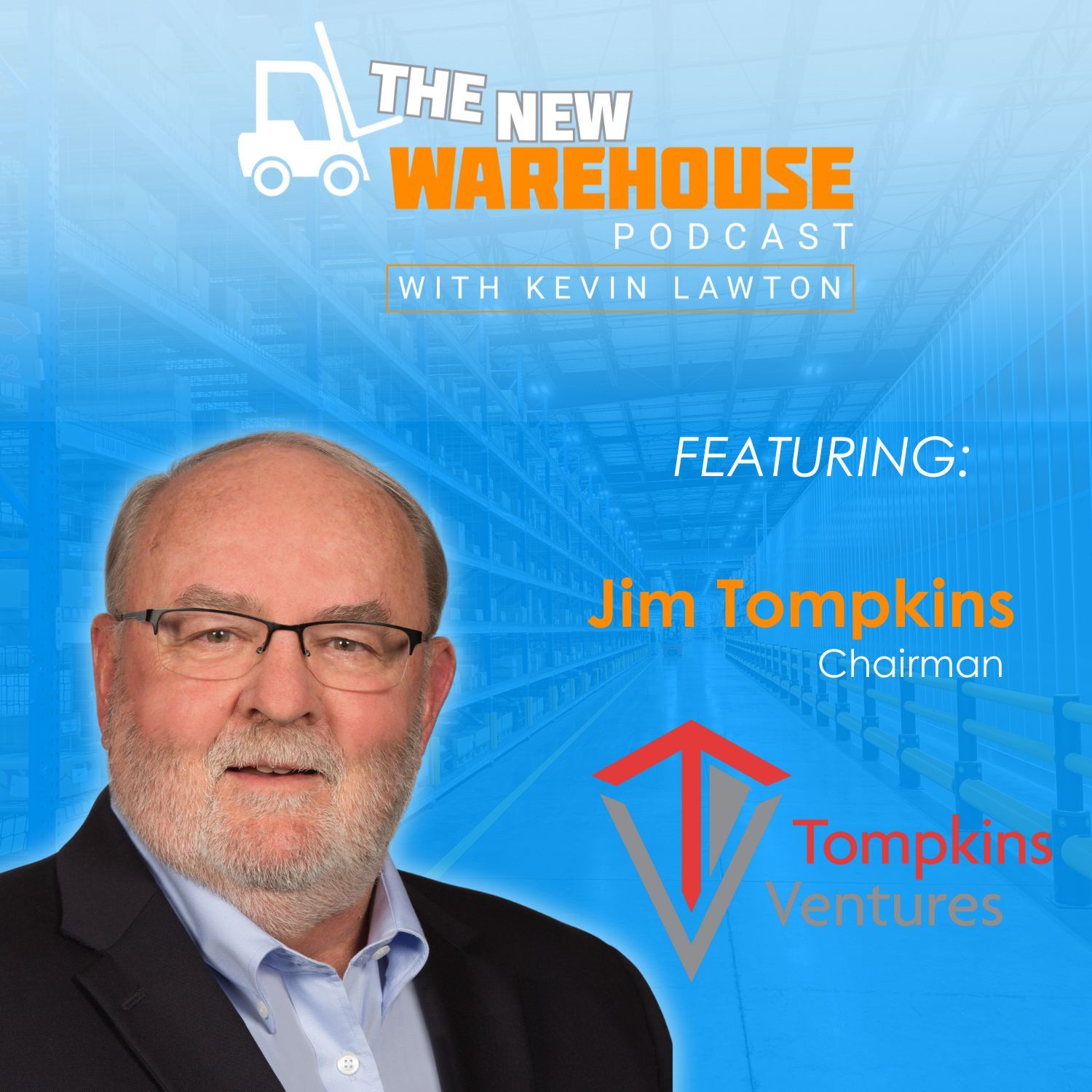
Tompkins Ventures: Building Supply Chain Resilience Amid Uncertainty
In this episode of The New Warehouse Podcast, Kevin sits down with Jim Tompkins, Chairman of Tompkins Ventures, to unpack what lies ahead for global supply chains. With decades of experience shaping logistics strategy, Tompkins brings a clear-eyed perspective on what 2025 revealed, and why 2026 will demand even greater adaptability.
The conversation explores tariff volatility, political uncertainty, and the strategic shifts leaders must make to stay competitive. From reshoring decisions to procurement’s expanding role, Tompkins explains why resilience is no longer optional.
Navigating Tariff Uncertainty Through Resilience
Tariffs dominated the supply chain conversation in 2025, but not in predictable ways. Tompkins described the year bluntly, saying, “anybody who predicted exactly what was gonna happen is either a liar or has been drunk for the year.” What began as economic policy quickly became political strategy, creating ongoing volatility.
He explained that many leaders expected tariffs to stabilize quickly, but that never happened. Instead, “we thought we would be done with this by now, and the fact of the matter is the churn continues to take place.” The challenge wasn’t just higher costs—it was the inability to plan with confidence.
Tompkins emphasized that resilience now defines success. “Resilience is the ability to bounce. When you get hit, how do you respond?” Companies that survived did not wait for clarity. They prepared for multiple outcomes and acted early. In today’s environment, supply chain leaders must assume volatility and build systems that adapt quickly rather than rely on stability returning.
Why Strategy Must Replace Optimization
For years, supply chain strategy focused on efficiency and optimization. That approach no longer works. Tompkins explained that traditional optimization fails when conditions shift constantly.
“What industrial engineers like to do is optimize everything,” he said. Tompkins emphasized that in today’s environment, flexibility and optionality matter more than pure optimization. Rather than perfecting one model, companies must prepare for several. That includes diversifying sourcing, modeling multiple tariff outcomes, and building response plans before disruptions occur.
One of the most effective strategies he observed was proactive scenario planning. “When the tariff jumped out from behind the rock, you said, ‘Oh, I have a strategy for that,’” Tompkins explained. That preparation allows leaders to act instead of freeze.
Tompkins lays out a simple, yet effective four-part strategy for supply chains.
- Be proactive
- Build resilience
- Embrace optionality
- Think outside the box (innovation)
The Long-Term Shift Reshaping Supply Chains
Looking ahead, Tompkins believes the changes underway are permanent. “Tariff churn isn’t about one policy,” he said. “It’s about living in a world where trade rules are written in pencil, not ink.”
One significant outcome is the rise of regionalized supply chains. Companies are moving closer to customers, reshoring or nearshoring production to reduce risk. This shift favors resilience over lowest-cost sourcing.
Technology also plays a central role. Tompkins pointed to AI, digital twins, and automation as essential tools for forecasting risk and improving decision-making. Ultimately, the message was clear: waiting is the greatest risk. “There’s risk in doing nothing, and there’s risk in doing something,” he said. “But doing nothing is not an option.”
Key Takeaways from Tompkins Ventures
- Tariff volatility is now a permanent feature of global trade
- Resilience and optionality matter more than cost optimization
- Political tariffs create greater uncertainty than economic ones
- Procurement is becoming a strategic leadership function
- Scenario planning is essential for managing risk
- Technology enables faster, smarter decision-making
- Companies that invest during uncertainty gain a long-term advantage
Listen to the episode below and leave your thoughts in the comments.
Guest Information
For more information on Tompkins Ventures, click here.
To connect with Jim Tompkins on LinkedIn, click here.
For more thought-leader insights like Tompkins Ventures, explore the podcasts below.
Smart Warehouse Technologies Driving Real-Time Operations