Flexible Fulfillment Automation in Practice
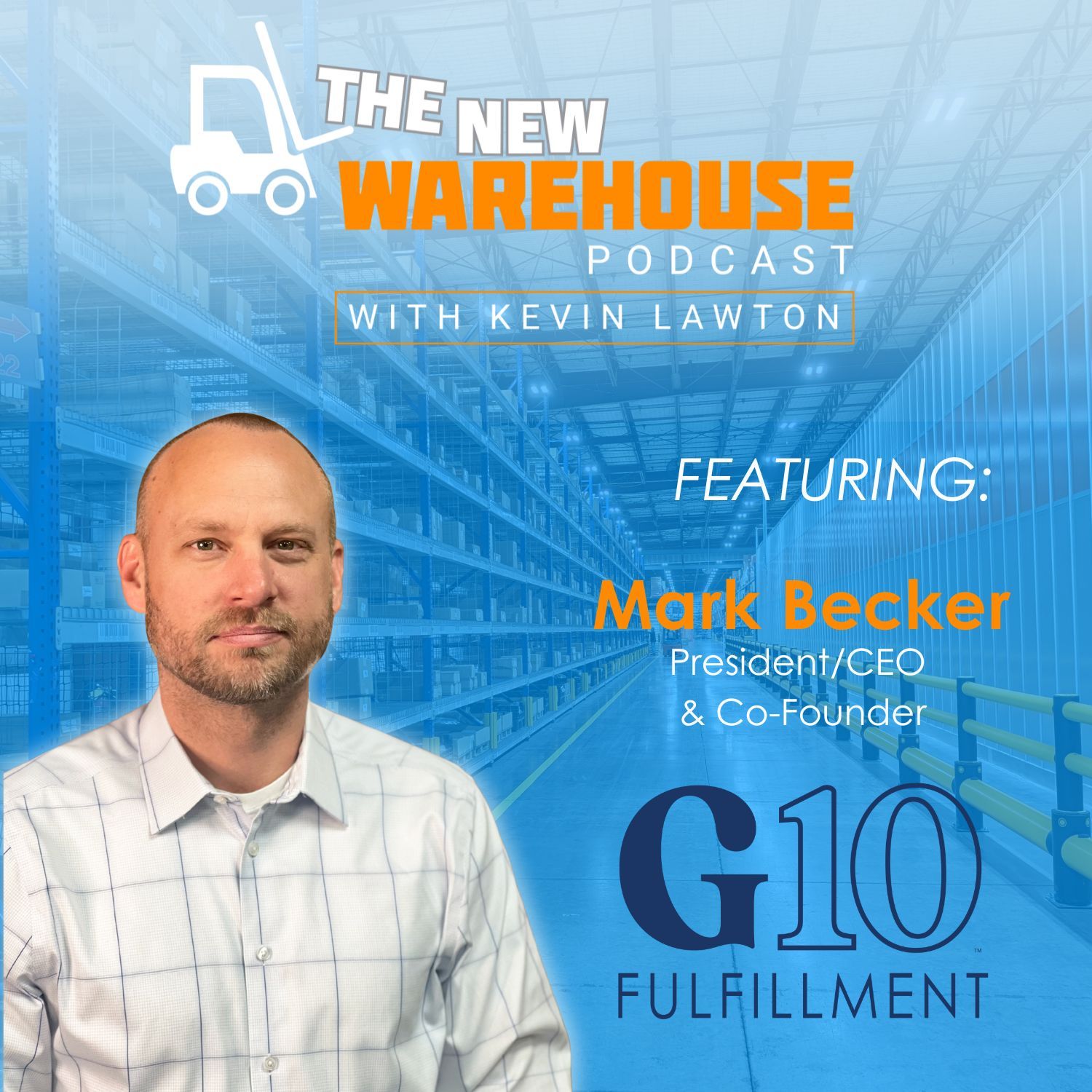
Welcome to this episode of The New Warehouse Podcast, where Kevin chats with Mark Becker, President, CEO, and co-founder of G10 Fulfillment. Becker shares how G10 has evolved from an early Amazon distributor into a national 3PL built around flexibility, technology control, and practical automation. With warehouses strategically placed across the U.S., G10 supports both direct-to-consumer and complex B2B fulfillment, including hazmat and oversized items like zero-turn lawnmowers.
The conversation explores why flexibility matters more than rigid efficiency models, how owning the tech stack enables faster pivots, and what real-world robotics adoption looks like on the warehouse floor. Becker also offers a grounded look at AI’s role in fulfillment, separating hype from practical gains as the industry heads into 2026.
Flexibility as the Core Fulfillment Strategy
For Becker, flexibility is not a buzzword. It is the reason G10 has scaled alongside changing retail expectations. “Being flexible has been our number one reason we’ve succeeded,” he explains. G10’s network of warehouses mirrors Amazon’s footprint, enabling fast two-day zone-three shipping while supporting full truckload compliance for retailers like Walmart and Lowe’s.
This flexibility extends to customer relationships. “We really look at ourselves as a partner to manufacturers in helping them scale,” Becker says, noting that G10 takes on operations so brands can focus on sales and marketing. When Amazon reduced prep services and penalized slow-moving inventory, G10 pivoted quickly. “We have the ability to react really quick…let’s pivot to an FBM model,” Becker says, helping clients avoid disruption while maintaining Prime-level service.
Owning the Tech Stack to Stay Ahead
“We control our own tech stack,” Becker says, explaining that their CTO and COO, Bryan Wright, originally wrote the warehouse management system. This ownership allows rapid customization as platforms like Amazon and Walmart evolve. G10 also built its own integration layer, Channel Point, handling APIs, EDI solutions, and data sharing entirely in-house. “That’s what’s allowed us…to react really quick,” Becker notes. The decision was not theoretical.
When G10 expanded from distribution into 3PL services, existing software could not handle both owned and non-owned inventory. That limitation forced a rethink and ultimately unlocked scale. “When we hired Bryan, that was when we said we can own our own tech,” Becker says, describing it as the moment G10 realized it could grow without waiting on vendors.
Robotics, AI, and Real-World Results
G10’s approach to flexible fulfillment automation is pragmatic. After years of incremental automation, Becker wanted robotics that enhanced flexibility rather than constrained it. Zebra’s cart-agnostic robots fit that need. “Our pick times…were sometimes more than three times faster than without the robots,” Becker says. The results were measurable. Pick rates increased from 35–45 orders per hour to more than 100. Accuracy improved slightly, even at higher speeds. The biggest concern was employee reaction. “Almost to an employee…they were like, ‘wow, this makes my job easier,’” Becker recalls.
Robots removed walking time and enabled zone-based picking powered by AI-driven path optimization. “For every 4,500 orders we ship, for every second we save is worth $3,000 throughout the course of the year,” Becker adds. Looking ahead, he sees AI automatically rebuilding algorithms. “The goal is…the AI machine should be able to rebuild it itself,” he says, pointing to 2026 as the year results become visible.
Key Takeaways on Flexible Fulfillment Automation
- Flexibility, not rigid efficiency, is the primary driver of long-term 3PL success.
- Strategically placed warehouses enable fast DTC delivery and complex B2B compliance.
- Owning the tech stack allows faster responses to Amazon and Walmart policy shifts.
- Robotics delivered more than 3× picking speed gains during peak operations.
- Zone-based, AI-driven picking reduced walking time and improved accuracy.
- Saving a single second per order can translate into thousands of dollars annually.
- AI is moving from discussion to measurable operational impact in 2026.
Listen to the episode below and leave your thoughts in the comments.
Guest Information
For more information on G10 Fulfillment, click here.
To connect with Mark Becker on LinkedIn, click here or email him at mark@G10fulfillment.com
For more information about flexible fulfillment automation, check out the podcasts below.
Warehouse Fulfillment Strategy for a Changing Consumer Landscape
630: Building Flexible Automation Solutions with Daifuku
628: Orchestrate Warehouse Automation Technologies with GreyOrange and enVista